

Red Willow battery storage permit passes 6–1
Cheryl Bowman, The Rural Alberta Report
November 20, 2026 at 9:01:02 a.m.
Local News
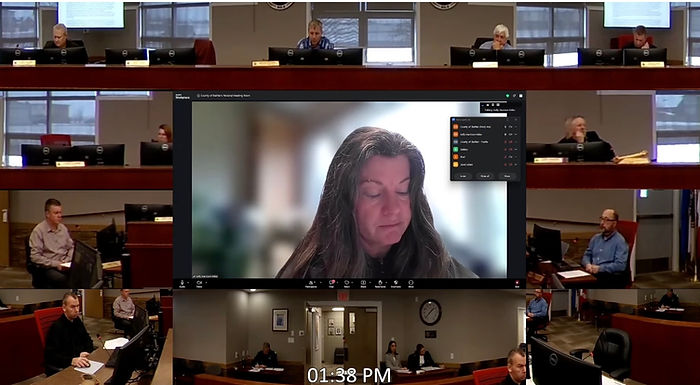
Photo: Kelly Harrison-Miles, centre, asks the County of Stettler’s municipal planning commission on Nov. 18 how soon neighbouring farms would be alerted to an emergency at the Red Willow battery storage facility. Screenshot from the County of Stettler meeting recording.
The County of Stettler’s municipal planning commission (MPC) voted 6–1 on Nov. 18 to approve Red Willow Solar Inc.’s 100-megawatt battery storage facility east of the hamlet of Red Willow. Before the vote, commission members tightened two permit conditions covering the firebreak around the batteries and the removal of equipment that is no longer in use.
The first amendment requires the 50-foot firebreak to consist of non-combustible material such as gravel or concrete. The draft permit would have allowed regularly mowed grass. The second amendment requires the company to contain and remove construction materials and to remove inoperable or redundant equipment in a timely manner. The motion to approve the application with the changes to conditions 3 and 12 carried with six in favour and one opposed.

The permit covers the first phase of the project south of Highway 601, where Red Willow Solar plans to install 105 battery units, 27 transformers and a substation. The Alberta Utilities Commission (AUC) approved the broader project in January, including a 225-megawatt solar plant about 18 kilometres northeast of Stettler. The solar panels were outside the scope of the Nov. 18 permit.
For Kelly Harrison-Miles, a concern was how soon neighbouring farms would hear about an emergency.
“At what point in an emergency response are we going to be notified when there is an issue?” Harrison-Miles asked. “As a farming industry we have our own safety plans that we have to make.”
Company representatives said they had just received her concerns and would provide a full response. They said Harrison-Miles lives within the project’s consultation area and would receive updates on the provincial regulatory process, emergency planning and noise monitoring.
When another resident called in to ask how an alert would go out, representatives said the system would notify the operations centre, which would then contact first responders. Coun. Justin Stevens asked whether neighbours would have an opportunity to learn about the emergency plan. Representatives said the company would follow up with neighbours annually and revise the plan as needed. They also said a facility operator living in Stettler would be on call.

Water supply drew a separate question from an online participant. County staff said the proposed storm pond east of the substation could contain up to two million litres of water during a fire. Representatives said they were still calculating how much water crews would need to cool the battery units and how much would have to be hauled to the site.
The permit requires two all-weather access roads from Range Road 18-2 before the batteries can be installed. Both must support a loaded fire truck or water tender year-round, giving crews a choice of routes depending on wind direction. Members also asked about spacing between batteries, gases released during a fire and firefighter training. Representatives said training would be provided in advance.
Reeve James Nibourg asked what would prevent a future operator from switching to a cheaper or less safe battery. Representatives pointed to the Tesla batteries specified in the project plans and the terms of the provincial approval. Nibourg also asked who would pay for cleanup after a catastrophic failure and whether insurance would cover an incident during operations.
Coun. Wade Hunter asked what would happen to batteries at the end of their service life, pressing representatives on whether the units would be hauled away or left on the property. Nibourg said the permit should explicitly require their removal. That requirement was included in the amended condition the commission adopted.
Stevens also asked how neighbours would learn of a change in ownership, saying a change in operators could affect public trust. Representatives said stakeholders would be notified and the approval conditions would continue to bind the new owner.


Latest News

Red Deer RCMP charge male with serious offences

Red Deer man faces attempted murder charge after loader pursuit

RCMP rescue hostage after hours-long standoff in Airdrie

Town of Stettler Celebrates 120 Years
